Basic Model of the New International Security System
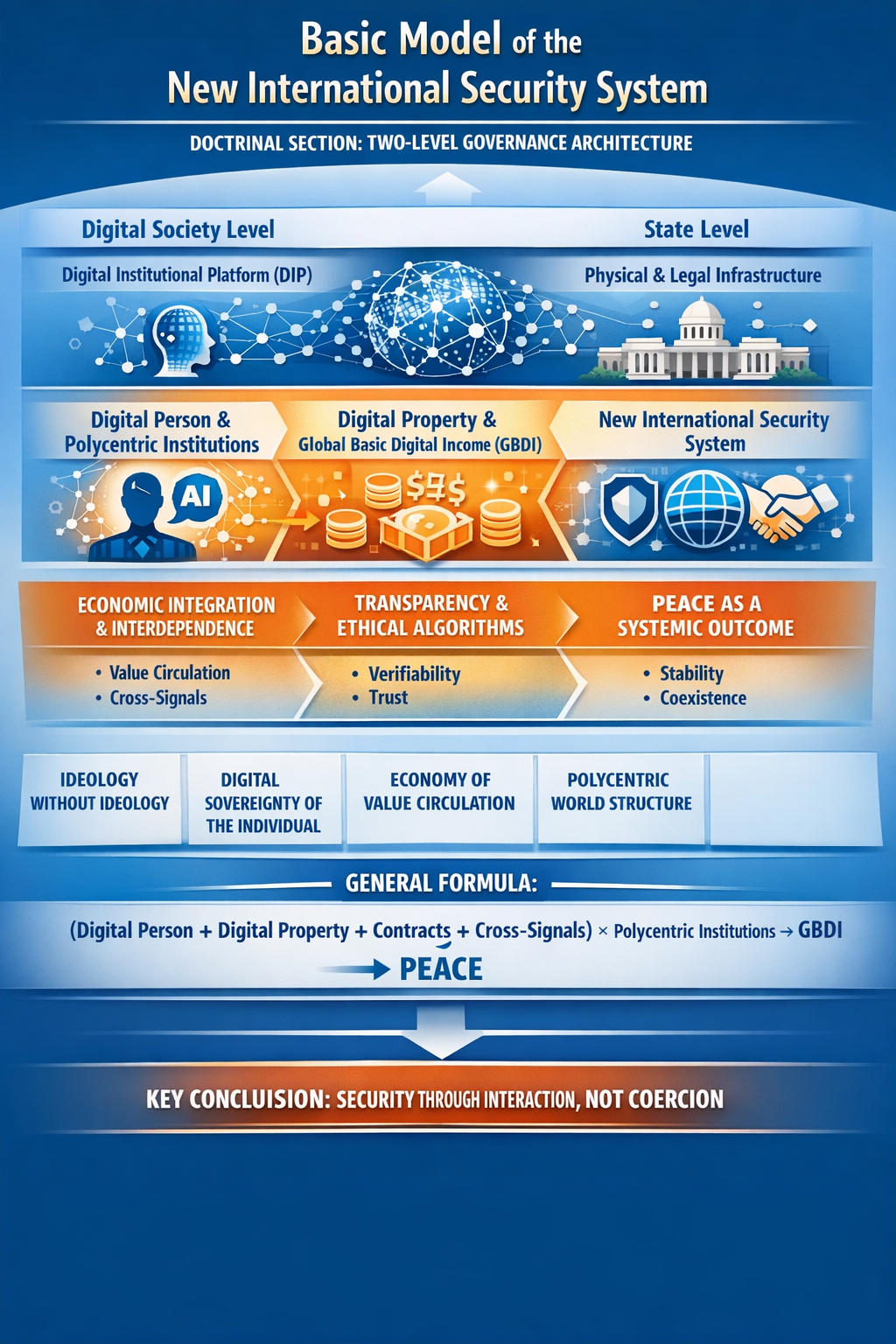
TWO-LEVEL GOVERNANCE ARCHITECTURE
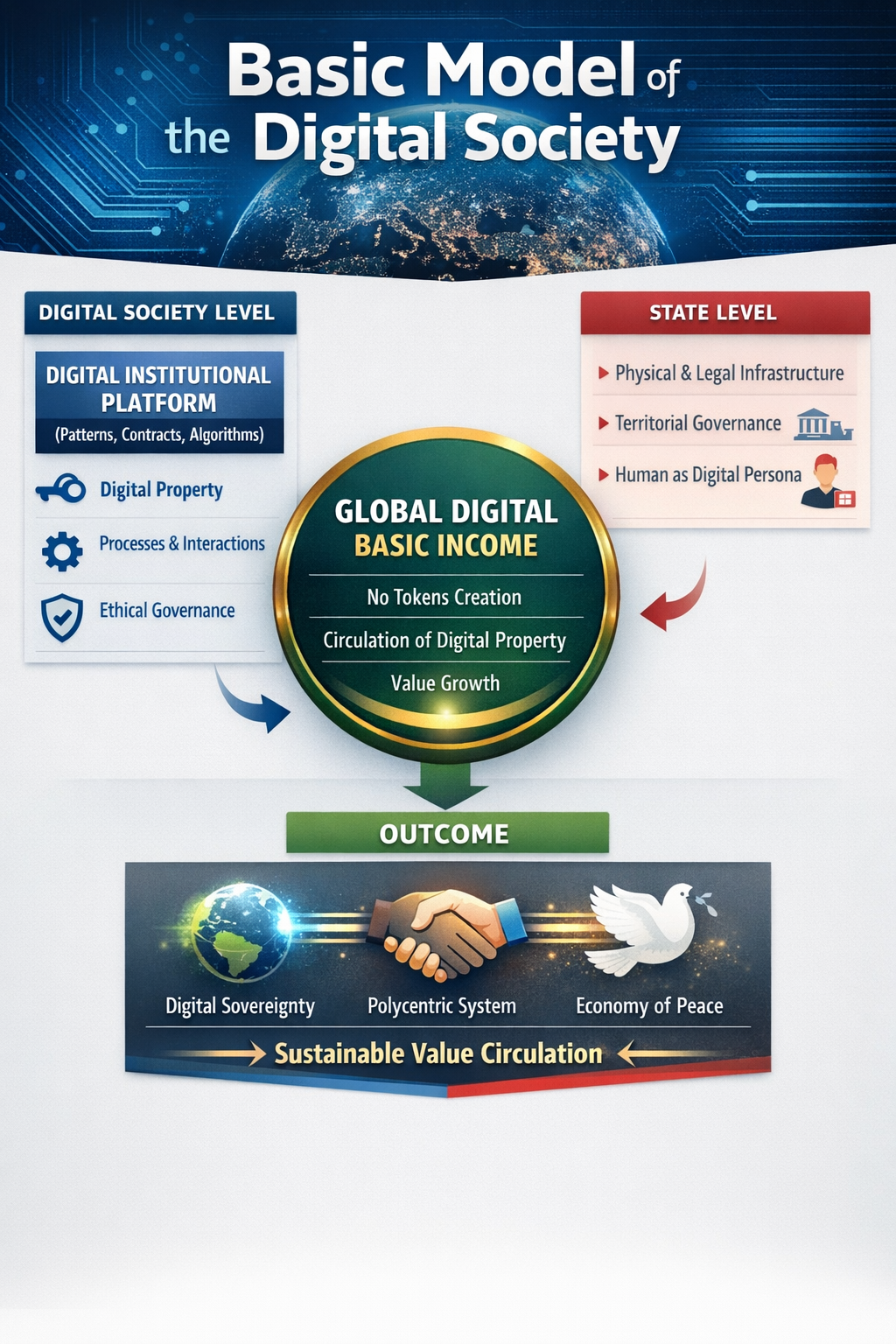
1. LEVEL OF THE DIGITAL SOCIETY
1.1. Essence
The digital society is represented as the Digital Institutional Platform (DIP) — a global system of self-governance of digital interactions operating on the basis of patterns, digital contracts, and ethical algorithms of polycentric institutions and their subplatforms.
It is not a state and does not replace the state.
It performs the function of the operating system of civilization.
2. LEVEL OF STATES
2.1. Essence
The state is a territorial institution responsible for the implementation of physical, social, and legal infrastructure.
It does not govern the digital society.
It integrates with the DIP as a physical executor within which a human acts as a digital person.
3. CORE INSTITUTIONS OF THE DIGITAL SOCIETY
3.1. Digital Person and Their Polycentric Institution
The digital person is the primary subject of the digital society — the bearer of rights, responsibilities, and participation in economic and social interactions.
Each individual is represented as a digital person with their own polycentric institution (CPI).
- personalized artificial intelligence acting in the interests of the individual
- responsibility for actions of personalized AI
- participation in digital contracts and economic circulation
- management of digital property
The personalized AI functions as an interface between the individual and the system:
- analyzes interactions
- optimizes contracts
- forms cross-signals
- ensures realization of rights
3.2. Digital Property
Digital property includes any digitized object capable of entering contractual relations:
- assets (energy, land, infrastructure)
- services
- data
- intellectual property
- behavioral patterns
- processes and interactions
It is a universal form of value representation, broader than tokenization.
3.3. Global Basic Digital Income (GBDI)
GBDI is a global automatic income generated from digital economic growth and distributed to all individuals.
- tokens exist as elements of contracts
- operate within legal frameworks
- backed by digital property
Value arises through circulation and interaction.
3.3.1. Source of GBDI: Circulation
Principle:
Not fees or taxation — but value growth through accelerated circulation.
Model:
$20T → DIP → acceleration → +$20–40T → GBDI fund
| Scenario | GBDI Fund | Per Person / Year |
|---|---|---|
| Minimum | $20T | ≈ $2 222 |
| Base | $30T | ≈ $3 333 |
| High | $40T | ≈ $4 444 |
4. NEW INTERNATIONAL SECURITY SYSTEM
4.1. Type
Security emerges as a property of interaction architecture, not coercion.
- stability of connections
- transparency
- verifiable ethical patterns
4.2. Source
Security arises from economic inclusion and interdependence.
- higher integration → lower conflict motivation
- transparency reduces asymmetry
5. PEACE AS A FUNCTION
Peace is not an agreement but a systemic outcome.
Economic integration removes rational grounds for war.
6. IDEOLOGY WITHOUT IDEOLOGY
The system does not impose beliefs.
It operates through patterns, contracts, and ethical algorithms.
7. CIVILIZATIONAL OUTCOME
- global economy of value circulation
- digital sovereignty of the individual
- polycentric world structure
8. GENERAL FORMULA
Digital Society = (Digital Person + Digital Property + Contracts + Cross-Signals) × Polycentric Institutions → GBDI → Peace
9. KEY CONCLUSION
The model forms a new security system based on interaction, not power.
Security emerges through economic inclusion, transparency, and interdependence.
Conflict loses economic meaning.
War ceases to be a tool.
Interaction becomes more beneficial than confrontation.
GBDI ensures stability and reduces structural causes of conflict.
States retain physical roles.
Security shifts to digital interaction.
Transformation:
— military-political → economic-digital
— coercion → coordination
— control → interaction
Additional Information:
Digital Society: Constitution of Peace and Institutional Architecture of Sustainable Development